The World Is Kinder on Foot
Kimberly Brookshire hiked North Carolina’s Mountains-to-Sea Trail twice, discovering what endurance, strangers’ kindness, and six months on foot could teach her.
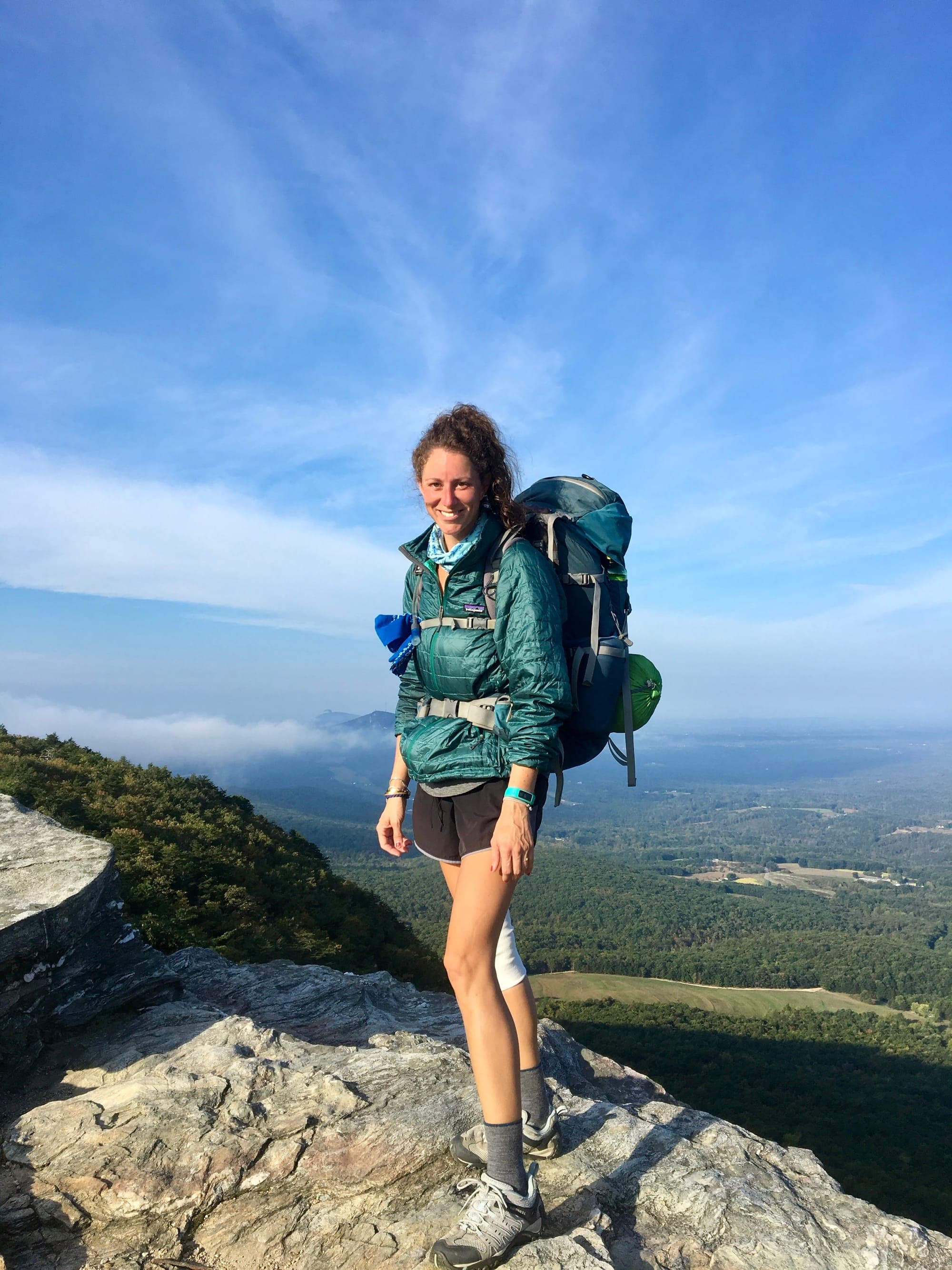
Somewhere around mile 258, I forded the Linville River in the early afternoon — thirty feet of slick rock and knee-high current, my hip belt unbuckled in case the water wanted to argue with me. It didn’t. I made it across without going fully under, dried off, laced back into my trail runners, and looked up. Shortoff Mountain. It’s a beautiful beast. Straight up. Seventeen hundred feet of climb from the river. Let’s go. I want to say I climbed it. What I actually did was survive it.
The sun that day had a personal stake in my suffering — no shade, no breeze, just heat pressing down on an exposed rock face while sweat ran down my arms and collected in places I didn’t know existed.
I found a flat spot, threw my pack down, lifted my shirt to let some air in, basically flashing the mountain. Four minutes of rest. Then back up. I started praying. Actual prayers. Please let me physically make it up this mountain. I told myself I was stopping so often to take pictures, to document the views. That was partly true. It was also a lie I needed to believe to keep moving. Three hours to cover 2.4 miles — I’m not proud of that number, and I’m not ashamed of it either. Seventeen hundred feet of climb. Merciless heat. I made it in spite of both.
When I finally pulled myself onto the summit, I dropped my pack, walked to the edge, and sat down. And then I cried. I was completely exhausted, and it was one of the most beautiful things I had ever seen, and both of those things arrived at exactly the same moment. Something had to give. Lake James glittered somewhere far below. The ridge went on in both directions like it had nowhere else to be. The thought that came fastest wasn’t relief. It was: Why don’t more people I know do this?
Later, trying to describe the feeling to myself, the most honest comparison I could land on was that it’s right up there with good sex. Not the best you’ve ever had — but the kind that gets the job done and leaves you satisfied down to your bones. It makes you want to scream. It does something to your insides.
The summit didn’t make me weep from joy alone — the climb had a hand in it too. You don’t get the view without paying for it first. That, more than anything, is what almost a month alone in the woods taught me: the mountain doesn’t care how hard the climb was. It hands you the view anyway, once you’ve earned it. And somewhere between the river and that ridge, I stopped needing anyone’s permission to go find out what I was capable of.
I didn’t have a good reason for setting off alone on a three-month hike across the state I grew up in. I had several. I wanted to challenge myself. I wanted out of a life that had started to feel like a rut I’d dug myself. There was a change I was carrying that I needed to walk off rather than sit with. And, honestly, I wanted to know — physically, not theoretically — if I could.
I wasn’t in shape for any of this. I didn’t work out, didn’t run, didn’t so much as own a pair of hiking boots before I bought the ones I wore on trail. The only thing I had going for me was that I liked hiking — and part of the plan, if I’m honest, was hoping the trail itself would whip me into shape along the way. I was about to find out the hard way whether liking something is the same as being ready for it — and I wasn’t the only one who doubted it.
The people who knew me best were the ones who doubted my decision the most. It’s too dangerous, they said. Alone? For three months? Are you sure you can even do that? My dad even offered to hire a guy to carry my pack and walk with me, just to make sure I’d be protected.
I noticed something, listening to them: the ones who loved me most were also the ones most certain I’d fail. I don’t think that was really about me. I think it was about them — about the fears they’d never tested on themselves, handed over to me instead, dressed up as concern. If I’d listened, the trail would still just be a name on a map to me.
But when I say I’m going to do something, I’m stubborn enough to actually do it. So I bought a pack, figured out how to use a water filter, took a few free classes on how not to die in the woods, and left.
By the time I stood on top of Shortoff Mountain a little over a month after starting my trek, sweat-soaked and crying and half-convinced I’d lost my mind, I understood something the doubters never could have told me, because they’d never climbed it themselves: the fear that stops you and the fear that means you’re doing something worth doing feel almost identical from the outside. You only find out which one you’re in by hiking anyway.
The Longest Day
That day started with a phone call. I was hiking on pavement so hot it was burning through the soles of my shoes, working on the layers of skin underneath, when my phone rang. It was the woman I nannied for. I stepped off trail to answer, and by the end of the call I was bawling. "Come back now," she said, "or don’t come back at all."
I hung up and didn’t move for a while. I ended up sitting outside a Dollar General next to a trash can that smelled exactly the way you’d expect a trash can to smell in July, and I let myself cry it out — the job, the kids, the version of my life I’d assumed I was still coming back to. And somewhere in that ugly, sweaty, gas-station-adjacent moment, I made a decision. Whatever came next, my choices were going to be mine. Not hers, not anyone’s. Mine.
I got back on trail not long after, trying to dry tears still streaming down my face. Hours later, the sky was doing the same thing. I’d left under a clear sky that morning, but it didn’t stay that way. By the time I crossed a long bridge, the clouds had gone dark and moody, rolling in fast and mean, and I knew before the first crack of thunder that I was in trouble. I was the tallest thing for miles in open country, so I dropped into a lightning position — crouched low, feet together — and then, when that didn’t feel like nearly enough, I sat down in the middle of the road and hoped. The drops rolling down my face now were rain, not tears, but by that point it was hard to tell the difference.
Seven minutes later, a car rolled to a stop beside me. A stranger cracked his window and yelled, “Get in!” He didn’t have to tell me twice.
James was headed the opposite direction. He didn’t mention it until later, after he’d already turned the car around. He told me not to worry about the seats — I was soaked through, dripping onto the upholstery of a car that clearly smelled better than I did — and he drove me all the way to the ferry station to wait out the storm, twenty minutes out of his way, without a second thought.
We talked the whole ride about what exactly I thought I was doing out there, alone, on foot, across the state. He gave me the same reaction most people did once they understood: a big grin and "That’s awesome." I still agree with him, even now, even though it meant giving up two miles of trail I’d have otherwise had to hike myself. I’ve made peace with that trade.
I’ve logged plenty of miles throughout my time on the Mountains-to-Sea Trail that never technically counted — trips into town for supplies, reroutes around closures, wrong turns I didn’t discover until a mile too late. Two miles in a stranger’s car, out of a thunderstorm that could have killed me, felt like the easiest math I did all trail.
James didn’t know me. He didn’t need to stop, didn’t need to let a soaked, sticky, exhausted stranger sit in his clean car, didn’t need to turn around and drive out of his way for someone he’d never see again. But he did it anyway, without knowing a single thing about me except that I needed help.
Later that same day, on the ferry out to the Outer Banks, close enough to the end that the words "You did it!" felt like they were waiting just offshore, I found a map of North Carolina posted inside the cabin. I put one finger on Clingmans Dome, where I’d started three months earlier. I put my other finger on Ocracoke, where the ferry was headed.
Days. I was days from finishing something almost no one thought I should start.
I want to be clear about what walking away means. I was giving up a job I loved, with children I loved — one of whom, the middle child, had my whole heart as hers — over one week. Except it was never really about the week. It was about who got to decide when my trail ended. I’d changed out there in ways I couldn’t fully explain yet, and one of the things that had changed was my willingness to let someone else make that call for me.
And I didn’t stop at just finishing. Staring at the distance between my two fingers on that map, I decided that when I reached the end, I’d turn around and hike the whole thing again — sea to mountains this time, the way I’d come, in reverse. The trail community has a name for that: a yo-yo. It would take another three months. I knew where the trail angels were now, which hotels to trust, what the terrain would demand of me. The seasons would be different, and so would I.
I was in the best physical, mental, and emotional shape of my life, and no woman had ever yo-yoed the trail. If I finished, I’d have a record no one could give me and no one could take away — and, more than that, I’d have proof of something in myself I still don’t think I’ve fully understood, even now.
Humans are mostly good, I learned, once you quit watching the news and go find them for yourself. That’s who I met that day — and it’s who I became, too. Not the version of me that quits when a mountain, or a boss, or a storm tells her to.
What the Trail Gave Back
I finished the yo-yo of the MST two days before Thanksgiving that year. I’d hiked 2,300 miles solo, crossing North Carolina twice, and surprised just about everyone I knew — and plenty of strangers along the way.
But the mileage wasn’t the biggest takeaway. Neither, really, was the record. I was. I learned that if I’d listened to the people who knew me best, who loved me the most, before I ever set foot on the trail, I might never have gone at all. Thankfully, trusting myself — even attempting something I had no experience with and knew almost nothing about — is what kept me out there.
After all those treacherous summit climbs, after burning through layers of skin on pavement so hot it should have been illegal, after crying alone in the middle of the woods, after falling, getting hurt, and getting back up knowing full well that no one was coming to save me, I understood that all of it was part of the journey. Without the hurt and the hard parts, I don’t think I could have felt the sweetest moments as fully as I did. I believe, all the way down, that the good only means anything alongside the bad.
I didn’t carry all of it alone, though. Strangers played a bigger part in that than I ever expected. Throughout the whole hike, they were some of the most caring and encouraging people I’ve ever had the pleasure of spending time with. They gave what they could — food, a place to stay, directions when I was turned around, a conversation when I badly needed one. Some doubted me. Most didn’t. Most just wished me well and meant it.
One hundred and fifty-four days after I’d first stood on it, I hiked back up to the summit of Clingmans Dome. Now around 2,000 miles in.
I made it to the summit forty minutes before dusk, just enough time to get my tent staked out and change out of hiking clothes I’d been sweating in since sunrise.
I FaceTimed a friend so he could enjoy the views with me, even from far away — the whole sky doing something enormous, the purple and pink fading into soft blues with a bright orange and blinding yellow sun just before it set over the mountains in the distance. It cast a glow that made even me, the dirtiest person on that summit, look almost radiant. I took pictures with the wind whipping my hair across my face, holding it down with one hand so I wouldn’t eat a mouthful of it in every shot. I remember thinking, even in the moment, that this was one of those rare stretches of life where you’re simply happy — not because anything happened to you, but because you built it yourself, mile by mile, over six months, with nothing but your own two feet and your own stubborn refusal to quit.
Alone, at the top of a mountain, with not a need in the world. And yet I had everything I’d ever wanted.
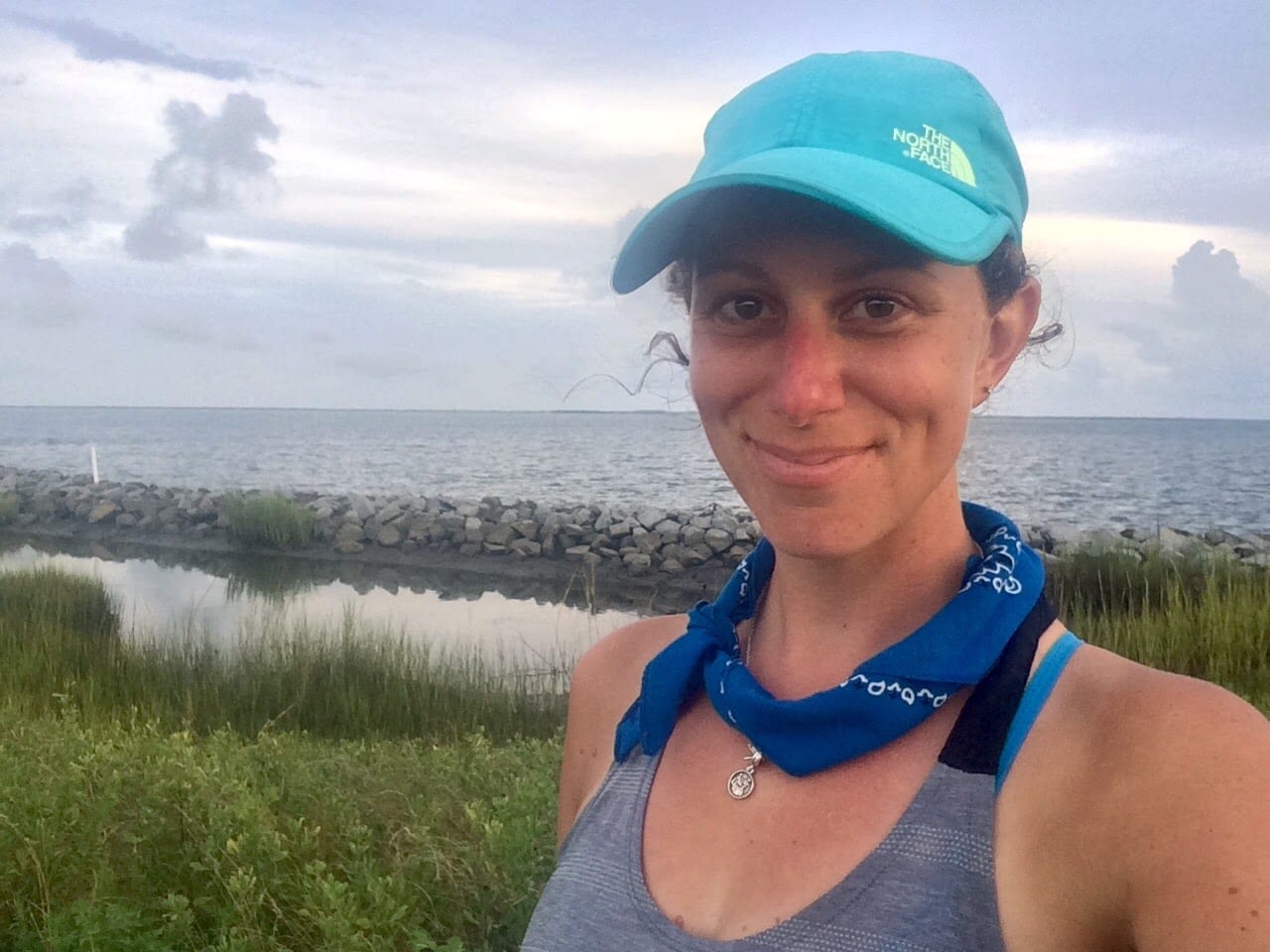
Follow along with Kimberly's adventures here.
Want more LIFE stories?
Join thousands of readers getting our best outdoor content. Free, no spam.
Join thousands of outdoor enthusiasts